


Introduction
Equity research remains one of the more selective entry points into finance, and firms hire on a narrow, testable set of equity research skills rather than general enthusiasm for markets. The demand is real: business and financial occupations are projected to grow faster than the average for all occupations from 2024 through 2034, with financial analyst roles particularly projected to increase 6%, which is more than two times the average occupational growth rate.
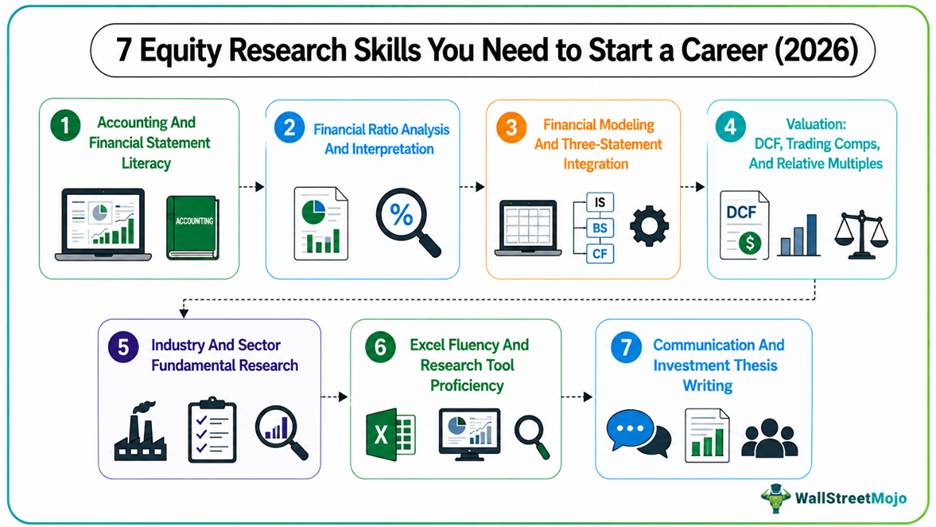
That said, growth in job openings does not mean the bar is low. Recruiters at banks, asset managers, and independent research firms screen candidates on a focused set of competencies. These equity research skills range from accounting literacy and valuation to communication. This article breaks down the seven skills beginners need most, explains what proficiency looks like, and shows practical ways to develop each skill.
Key Takeaways
- Master financial statements first, as accounting literacy provides the foundation for modeling and valuation.
- Develop skills required for equity research through structured practice in modeling, valuation, sector research, and communication.
- Learn three-statement modeling with clean, auditable formulas and real company case studies rather than scattered tutorials.
- Combine DCF and trading comps to develop more informed valuation views and understand differences between valuation methods.
- Strengthen Excel, research tools, and investment thesis writing to communicate analysis clearly and defend recommendations.
1. Accounting And Financial Statement Literacy
Equity research skills for beginners start with the ability to read and analyze the income statement, balance sheet, and cash flow statement. This is because every model and valuation an analyst produces depends on the quality of those inputs.
An analyst who cannot separate operating cash flow from net income, or who misses aggressive revenue recognition buried in a footnote, will build models on a shaky foundation no matter how strong their Excel skills are. This is typically the first thing tested in interviews, often through a case study built around a real 10-K or annual report. Working through actual filings, such as McDonald’s or Colgate’s annual reports, builds this instinct significantly faster than memorizing textbook definitions.
2. Financial Ratio Analysis And Interpretation
Ratio analysis converts raw financial statements into comparable signals of liquidity, profitability, leverage, and efficiency, which lets an analyst rank the companies within a sector instead of judging them in isolation.
This is one of the most frequently tested equity research skills because it is also easy to verify in a live interview. A common beginner mistake is memorizing formulas without understanding what the ratio implies about the underlying business. A current ratio of 1.2 means something very different for an asset-light software company than it does for a retailer holding six months of inventory.
The key ratio categories below show which metrics equity research analysts use and what each category reveals about a company:
| Ratio Category | Example Metrics | What It Signals |
| Liquidity | Current ratio, quick ratio | Ability to meet short-term obligations |
| Profitability | Gross margin, ROE, ROIC | Efficiency of converting sales into profit |
| Leverage | Debt-to-equity, interest coverage | Balance sheet risk and solvency |
| Efficiency | Asset turnover, inventory days | How well assets generate revenue |
| Valuation | P/E, EV/EBITDA, P/B | Relative pricing versus peers and history |
3. Financial Modeling And Three-Statement Integration
Financial modeling is the skill that links the income statement, balance sheet, and cash flow statement into one dynamic, forecastable structure. It is consistently among the most requested equity research skills in job postings.
A three-statement model forces internal consistency: a change in revenue growth has to flow through working capital, the debt schedule, and retained earnings without breaking the balance sheet. Beginners routinely underestimate how much time goes into building clean, auditable formulas rather than hardcoded numbers, and this is exactly where sloppy habits get exposed under interview pressure. Structured, sequenced practice tends to outperform scattered tutorials here. This is because a single modeling error compounds through every downstream valuation step. WallStreetMojo’s Equity Research Course builds this progressively, moving learners from accounting fundamentals into a full three-statement model using a case study before introducing valuation.
4. Valuation: DCF, Trading Comps, And Relative Multiples
Valuation turns a financial model into an actionable investment view, most commonly through discounted cash flow analysis, trading comparables, and precedent transaction analysis.
DCF valuation requires an analyst to state explicit assumptions about growth, margins, and the weighted average cost of capital. These are key areas that portfolio managers and interviewers probe. Trading comps, by contrast, anchor a company’s value to how the market currently prices similar businesses using EV/EBITDA, EV/EBIT, and P/E multiples. Strong analysts run both methods together rather than relying on one. This is because DCF and comps frequently disagree, and the size of that gap is itself informative.
5. Industry And Sector Fundamental Research
Fundamental research is one of the essential equity research skills for building an informed view of an industry’s structure, competitive dynamics, and demand drivers. It is what separates a spreadsheet technician from an analyst whose recommendations get trusted.
In practice, this means reading competitor filings, tracking regulatory changes, following management commentary across earnings calls, and understanding where a company sits in its industry’s cost or pricing structure. A skilled analyst can explain why a company’s margin is expanding or contracting in terms of the business itself, not just the numbers. This skill is harder to teach directly, but it develops fastest through repeated case studies across different sectors rather than deep focus on a single industry.
6. Excel Fluency And Research Tool Proficiency
Beyond formulas, equity research demands comfort with the specific data sources analysts rely on daily. Knowing where to find reliable company and industry data helps analysts build and defend a thesis more efficiently.
Entry-level analysts rarely get access to premium terminals like Bloomberg or FactSet on day one. So, building fluency with free, public resources is a more realistic starting point. SEC EDGAR gives direct, no-cost access to filings and transcripts, and pairing that with clean Excel-based comps and ratio templates covers most of what an entry-level role requires before institutional tools enter the picture.
The following table summarizes the main tools used in equity research, their primary use cases, and typical access levels.
| Tool | Primary Use Case | Typical Access Level |
| Excel | Model building, sensitivity analysis | Universal, entry-level |
| SEC EDGAR | Free access to filings and transcripts | Universal, free |
| Bloomberg Terminal / FactSet | Real-time data, cross-asset research | Institutional, paid |
| Company annual reports / investor decks | Primary source research | Universal, free |
| Industry association data | Sector benchmarking | Varies by industry |
7. Communication And Investment Thesis Writing
An equity research analyst’s output is only as valuable as their ability to communicate it. A model that never gets read cannot influence an investment decision.
That means writing a clear buy, hold, or sell recommendation and defending price targets under direct questioning. It also means structuring an investment memo so that a portfolio manager can absorb the thesis in minutes rather than hours. This is one of the most under-practiced equity research skills among beginners, who tend to over-invest in model precision and under-invest in the clarity of the argument the model is supposed to support.
Conclusion
Starting a career in equity research requires building a focused set of core skills, including accounting, modeling, and valuation. These skills also include ratio analysis, sector research, tool fluency, and clear communication. Beginners should build these skills in sequence rather than jumping into valuation without a solid accounting foundation.
For a structured path that builds accounting, ratio analysis, financial modeling, DCF, and trading comps in sequence with certification and downloadable Excel templates, the WallStreetMojo Equity Research Course is worth reviewing before piecing together a self-taught path from scattered resources.
Frequently Asked Questions
What is the most important skill for equity research beginners?
Financial statement literacy and three-statement modeling are among the most important equity research analyst skills. After all, every valuation output depends on the accuracy of the underlying model.
Do I need a finance degree to start a career in equity research?
No, a finance degree is not strictly required. That said, most successful candidates demonstrate the same accounting, modeling, and valuation skills a finance degree would teach, regardless of how they acquired them.
Is a CFA required to start a career in equity research?
No, a CFA is not required for entry-level roles. However, it strengthens credibility for research-heavy and buy-side positions and correlates with higher long-term compensation.
What is the typical salary for an equity research analyst?
The average annual salary for an equity research analyst in the United States is $76,342 as of August 01, 2026, according to Salary.com. Meanwhile, in India, the typical annual range for equity research analysts’ salary is ₹10.9 lakh-₹12 lakh for 0 to 7 years of experience, per AmbitionBox. Note that the compensation varies on the basis of different factors like the firm, region, and experience.
How important is Excel for equity research careers?
It is very important. Nearly every model, comp set, and valuation output an analyst produces is built and delivered in Excel, so speed and accuracy in Excel directly affect how much ground an analyst can cover.
Can I build equity research skills online without prior finance experience?
Yes, self-paced online courses covering accounting, ratio analysis, modeling, and valuation can build job-ready equity research skills. The material should be in proper sequence and include real company case studies rather than isolated formula drills.