


Introduction
Every year, thousands of finance students, career switchers, and working professionals look for a reliable way to break into deal-making. Most run into the same wall: conflicting advice, scattered tutorials, and courses that promise Wall Street skills without a clear sequence. Learning investment banking is not about memorizing formulas. It is a layered skill set that starts with accounting fundamentals and progresses through Excel modeling, valuation, and deal structuring. Each stage builds on the skills learned in the previous one.
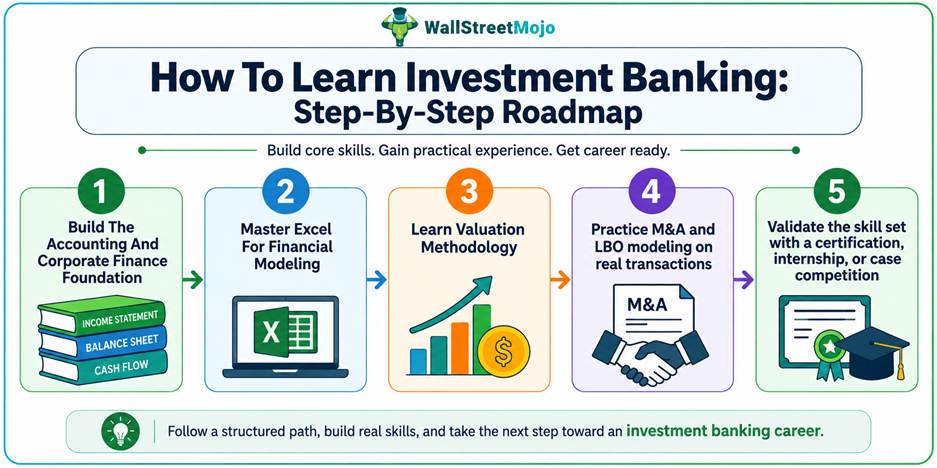
Learning investment banking requires mastering financial accounting and building three-statement models in Excel. You also need to learn valuation methods such as DCF and comparable company analysis. Finally, practice M&A and LBO modeling on real deals and validate your knowledge through a recognized certification or internship.
This guide explains how to learn investment banking in detail, compares realistic learning paths from self-study to structured certification programs. Moreover, it flags the mistakes that slow most beginners down.
Key Takeaways
- Build accounting and corporate finance fundamentals before progressing to Excel modeling, valuation, and deal analysis.
- Master Excel, including shortcuts, formula auditing, and formatting, to build efficient and reliable financial models.
- Learn DCF, comparable company, and precedent transaction analysis to develop strong valuation skills.
- Practice M&A and LBO modeling using real transactions to understand debt, synergies, and accretion/dilution.
- Validate your skills through certifications, internships, or case competitions that provide tangible evidence of your capabilities.
- Follow a structured learning sequence and apply concepts through practical exercises, case studies, and interview preparation.
What Does It Take To Learn Investment Banking?
Understanding how to learn investment banking starts with knowing how the role combines accounting, corporate finance, and negotiation. Analysts build financial models, value companies, prepare pitch materials, and support live transactions such as mergers, acquisitions, and capital raises.
A key part of how to learn investment banking is developing fluency in three areas: financial statement analysis, Excel-based modeling, and valuation theory. Structured investment banking skills training programs sequence these deliberately. This is because attempting DCF valuation before understanding how the three statements connect produces models that look correct but break under scrutiny.
Recruiters at bulge bracket and boutique banks alike test this layered knowledge in technical interviews. They ask candidates to walk through how a change in depreciation flows through the three statements. That single question filters out candidates who learned formulas without understanding the mechanics beneath them.
How To Learn Investment Banking Step by Step
The most effective approach regarding how to learn investment banking follows a fixed sequence rather than a scattered mix of topics. The stages below reflect how most structured programs, and most investment bank training curricula, actually order the material.
1. Build The Accounting And Corporate Finance Foundation
Learn to read an income statement, balance sheet, and cash flow statement fluently before opening Excel, covering revenue recognition, working capital, depreciation schedules, and capital structure basics.
2. Master Excel For Financial Modeling
Investment banking runs on Excel, not specialized software. Keyboard shortcuts, formula auditing, and clean formatting conventions matter as much as formula logic under tight deadlines.
3. Learn Valuation Methodology
This covers discounted cash flow (DCF) analysis, comparable company analysis (comps), and precedent transaction analysis. Interviewers routinely ask candidates to reconcile differences between the three.
4. Practice M&A And LBO Modeling On Real Transactions
Reading about a leveraged buyout differs from building one. Working through actual deals forces a learner to confront debt schedules, accretion/dilution math, and synergy assumptions that theory alone does not teach.
5. Validate The Skill Set With A Certification, Internship, Or Case Competition
External proof of competence gives recruiters tangible evidence of your skills rather than relying solely on your claims.
For career switchers wondering how to learn investment banking from scratch, skipping accounting for LBO tutorials can create problems during interviews. Sequence matters more than speed.
Best Way To Learn Investment Banking: Comparing the Realistic Paths
There is no single answer to how to learn investment banking because the right path depends on your goals, budget, and timeline, and whether you need interview-ready technical depth or a broader career-change credential. This table compares the main options available today:
| Learning Path | Best For | Core Curriculum | Certification | Strength | Limitation |
| Self-study | Exploring interest first | Basic accounting, Excel, statement analysis | None | Low-cost and flexible | No structured guidance or feedback |
| Wall Street Prep | IB interview prep | Financial modeling, DCF, M&A, LBO, valuation | Certificate available | Practical, job-focused training | Primarily focused on technical skills |
| Breaking Into Wall Street (BIWS) | Self-paced modeling depth | 3-statement modeling, DCF, LBO, M&A, sector modeling | Certificate available | Extensive video-based training | Can be demanding for beginners |
| CFI (FMVA) | Broad financial modeling skills | Modeling, valuation, budgeting | FMVA credential | Broad finance curriculum | Broader finance focus beyond investment banking |
| WallStreetMojo IBMP | Beginners seeking a structured IB roadmap | 91+ hours of video content: Covers modeling, DCF, LBO, M&A, markets, derivatives, credit, accounting, corporate finance | 20+ Certificates available | Taught/Directed by a former JPMorgan/CLSA analyst; bundles the full sequence | Best for those wanting the full roadmap, not one narrow topic |
For learners who want the full roadmap, from accounting through deal mechanics, a bundled program can provide a more connected learning experience.
Instead of piecing together separate courses from different platforms, a program such as the Investment Banking Master Program offers a structured sequence that brings the key areas together.
Core Skills Every Investment Banking Learner Needs
Understanding how to learn investment banking also means developing the four skill categories that separate interview-ready candidates from course completers. Let us look the categories.
- Financial statement modeling: Building linked three-statement models that update dynamically when assumptions change
- Valuation judgment: Knowing when to weight DCF over comps, and defending assumptions like discount rate and terminal growth
- Deal mechanics: Understanding how debt, equity, and synergies interact in M&A and LBO structures
- Communication under scrutiny: Defending a model’s output and assumptions in a pitch or interview setting through practical, case-study-based application
Common Mistakes to Avoid When Learning Investment Banking
Knowing how to learn investment banking effectively also means avoiding the following common mistakes that slow beginners down:
- Focusing on theory without building practical modeling skills
- Memorizing formulas without understanding the underlying financial concepts
- Learning individual topics without connecting them to the broader investment banking workflow
- Relying solely on passive video learning without applying concepts through exercises and case studies
- Building models without learning to explain and defend the assumptions and outputs
- Preparing for interviews without practicing real-world deal scenarios
- Overlooking accounting and financial statement fundamentals
Career Outcomes and Market Context
Deal activity remains an important part of the investment banking market. Global M&A deal value is on track to reach approximately $4 trillion in 2026, according to PwC. This level of deal activity highlights the continued importance of investment banking skills.
The broader financial analyst profession also has a positive outlook. The U.S. Bureau of Labor Statistics projects 7% employment growth for financial analysts from 2025 to 2035, with about 29,500 openings annually. The median annual wage for financial and investment analysts was $102,740 in May 2025.
This outlook reflects continued demand for professionals who can evaluate financial data, assess investment opportunities, and help businesses make informed financial decisions.
The outlook and compensation can vary significantly across markets. In India, investment banking analyst compensation varies significantly by employer, location, and experience. AmbitionBox currently reports average salary range of ₹14 lakh to ₹15.5 lakh per year. These figures are based on reported salary data and should be treated as indicative rather than fixed benchmarks. These figures are based on reported salary data and should be treated as indicative rather than fixed benchmarks.
Conclusion
For anyone wondering how to learn investment banking, the answer is a structured approach that builds skills in sequence. Moving through accounting, Excel modeling, valuation, and deal mechanics in sequence, then validating that knowledge through practice and certification, builds the kind of technical fluency recruiters test for directly.
Learners who want that sequence delivered as one connected program, rather than assembled from separate courses, can review the curriculum and instructor background behind the Investment Banking Master Program before choosing a starting point.
Frequently Asked Questions
How long does it take to learn investment banking?
Reaching interview-ready competence typically takes three to six months of consistent study for someone starting with basic accounting knowledge. That said, mastering advanced modeling and deal mechanics is an ongoing process that continues well into an analyst’s early career.
Can I learn investment banking without a finance degree?
Yes, a finance, commerce, accounting, or economics background can be beneficial. That said, structured courses and certifications let career switchers from other fields build the required accounting, Excel, and valuation skills without returning to a full degree program.
What is the best way to learn investment banking for beginners?
Beginners generally benefit most from a structured, sequenced program that starts with accounting and Excel before moving into valuation and deal modeling, rather than jumping directly into advanced LBO or M&A tutorials. This approach provides a clear framework for how to learn investment banking and build the required skills progressively.
Do I need a CFA to work in investment banking?
No, a CFA charter is not a prerequisite for entry-level investment banking roles. Nevertheless, many professionals pursue it later for credibility in research-heavy or asset management-adjacent roles.
What skills matter most for investment banking interviews?
Interviewers focus on three-statement modeling fluency, and valuation judgment across DCF and comps. Moreover, the ability to explain how a change in one assumption flows through an entire model is also important to them.
Is investment banking still a good career given AI automation?
Deal volume and megadeal activity remain strong heading into 2026, and while AI tools are automating routine model-building tasks, the judgment required to structure deals and defend assumptions still depends on analysts who understand the underlying mechanics.