


Introduction
Investment banking remains one of the most competitive and rewarding career paths in finance. Whether the goal is to work on mergers and acquisitions, capital raising, IPOs, or valuation advisory, the field demands a diverse skill set. Firms expect candidates to possess technical expertise, business acumen, and professional skills before entering the industry. The good news is that these skills can be learned with the right combination of structured training, practical projects, and consistent practice.
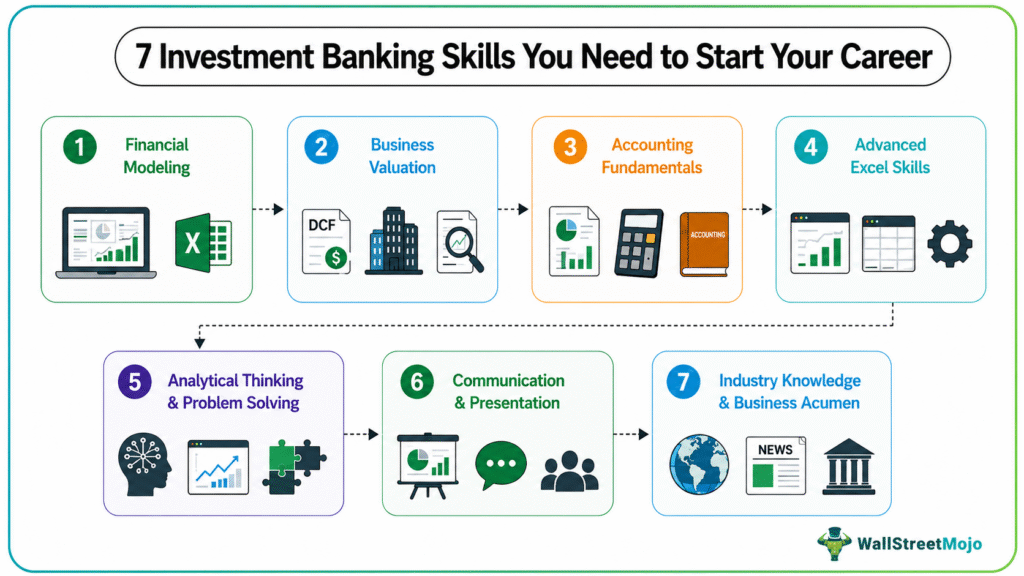
This guide explains the seven most important investment banking skills recruiters look for, why each skill matters, and how beginners can develop them. It also discusses how practical training programs, such as the Investment Banking Master Program by WallStreetMojo, help bridge the gap between theoretical knowledge and real-world investment banking work.
Key Takeaways
- Financial modeling is the most important technical skill for aspiring investment banking professionals.
- Strong accounting, valuation, and Excel skills form the foundation of investment banking success.
- Communication and presentation skills are essential for explaining financial insights to clients and stakeholders.
- Hands-on projects and case studies help develop practical, job-ready investment banking skills.
- Recruiters value candidates who combine technical expertise with analytical thinking and problem-solving abilities.
- A structured learning path accelerates skill development and improves investment banking career readiness.
Why Investment Banking Skills Matter
Investment bankers advise corporations, institutional investors, private equity firms, and governments on high-value financial transactions. Their work involves building complex financial models, valuing businesses, preparing presentations for clients, and analyzing strategic decisions.
Unlike many finance jobs, the investment banking skills required include a combination of technical expertise, analytical thinking, and communication skills that professionals must apply simultaneously.
For example, while evaluating an acquisition target, an analyst may need to:
- Build an integrated three-statement financial model
- Perform Discounted Cash Flow (DCF) valuation
- Compare trading and transaction multiples
- Prepare pitch books in PowerPoint
- Present findings to senior bankers
This explains why employers often prioritize demonstrable skills over academic qualifications alone.
Building the right skill set is becoming increasingly important as organizations place greater emphasis on practical competencies. According to a CFA Institute study of more than 100 finance and investment firms in India, 68% of employers prioritize market and product knowledge, 51% value financial modeling skills, and 49% emphasize communication and stakeholder management skills when evaluating candidates. These findings highlight the importance of developing both technical expertise and professional competencies to succeed in investment banking.
Now, let us look at the seven skills that form the foundation of a successful investment banking career and are highly valued by recruiters.
1. Financial Modeling
Financial modeling is the process of building spreadsheet models that forecast a company’s future financial performance. It is widely regarded as one of the top investment banking skills because it supports valuation, mergers and acquisitions, and capital-raising decisions.
Investment bankers use them to:
- Value companies
- Analyze acquisitions
- Evaluate mergers
- Assess leveraged buyouts
- Forecast operating performance
What Recruiters Expect
Among the investment banking skills required, recruiters typically look for proficiency in:
- Three-statement modeling
- Revenue forecasting
- Cost projections
- Debt schedules
- Working capital modeling
- Scenario and sensitivity analysis
Example
Suppose a technology company plans to acquire a competitor. An investment banking analyst develops a model that shows the following:
The model helps decision-makers evaluate whether the acquisition creates shareholder value.
2. Business Valuation
Business valuation estimates the intrinsic or market value of a company. Every investment banking deal requires valuation.
Investment bankers use several valuation methods to estimate a company’s worth, depending on the transaction and available information. The table below highlights those techniques.
| Valuation Method | Primary Use |
| Discounted Cash Flow (DCF) | Intrinsic valuation |
| Comparable Company Analysis (CCA) | Relative valuation |
| Precedent Transactions | M&A pricing |
| Asset-Based Valuation | Asset-heavy businesses |
| Leveraged Buyout (LBO) Analysis | Private equity deals |
Investment banking interviews frequently test valuation concepts because they directly relate to client work.
Example
Before an IPO, bankers estimate the company’s fair valuation using multiple valuation techniques before recommending an offer price.
3. Accounting Fundamentals
Investment bankers analyze financial statements every day. Without accounting knowledge, financial modeling becomes difficult.
Here are the key things candidates should understand:
- Income Statement
- Balance Sheet
- Cash Flow Statement
- Revenue recognition
- Depreciation
- Deferred taxes
- Working capital
- Financial ratios
Interview Relevance
Common interview questions include:
- Walk me through the three financial statements.
- How does depreciation affect all three statements?
- What happens when inventory increases?
Strong accounting knowledge allows candidates to answer these confidently.
4. Advanced Microsoft Excel Skills
Excel remains the primary tool used by investment bankers worldwide. Some essential Excel skills are as follows:
- Keyboard shortcuts
- Lookup functions
- INDEX-MATCH and XLOOKUP
- Dynamic formulas
- Financial functions
- Pivot Tables
- Scenario analysis
- Data validation
- Error handling
- Charting
One must remember that speed also matters. Investment banking analysts often build or modify financial models under tight deadlines. The ability to navigate Excel efficiently can significantly improve productivity.
5. PowerPoint and Pitch Book Preparation
PowerPoint proficiency is essential in investment banking because analysts use pitch books to communicate complex financial information and strategic recommendations to clients. These presentations typically include:
- Company valuation
- Industry research
- Strategic recommendations
- IPO proposals
- M&A opportunities
- Market analysis
Recruiters value candidates who understand:
- Slide structure
- Financial charting
- Data visualization
- Storytelling with numbers
- Professional formatting
Although often overlooked, presentation skills remain an essential part of any investment banking skills checklist, helping analysts communicate complex financial information clearly and profession.
Example
A merger pitch book prepared for a client may be structured as follows:
- Industry overview
- Company profile
- Valuation summary
- Synergy estimates
- Transaction timeline
- Risks
- Recommendation
6. Analytical and Problem-Solving Skills
Investment banking involves solving complex financial problems rather than simply performing calculations. Analysts regularly answer questions such as the following:
- Should Company A acquire Company B?
- Is this IPO fairly priced?
- Which financing option minimizes cost?
- How sensitive is valuation to changing assumptions?
Strong analytical thinking enables professionals to:
- Interpret financial data
- Identify trends
- Evaluate risks
- Build logical investment recommendations.
This skill becomes increasingly important as professionals progress into Associate and Vice President roles.
7. Communication and Presentation Skills
Communication and presentation skills are essential because investment bankers must explain complex financial analyses and strategic recommendations to clients, senior executives, and internal teams. Throughout a transaction, they regularly communicate with:
- Clients
- Senior executives
- Investors
- Legal advisors
- Auditors
- Internal deal teams
Candidates should develop the following communication and presentation skills:
- Business writing
- Presentation skills
- Executive summaries
- Data storytelling
- Professional email communication
- Client interaction skills
Even during interviews, recruiters evaluate how clearly candidates explain technical concepts. For example, explaining DCF valuation in simple language demonstrates both technical understanding and communication ability.
How to Develop Investment Banking Skills
Developing investment banking skills for beginners requires more than reading textbooks. Employers increasingly prefer candidates who can demonstrate practical experience through projects and case studies.
Use the following investment banking skills checklist as a roadmap for building the technical and professional competencies expected in analyst roles:
| Step | What to Learn |
| Step 1 | Accounting fundamentals |
| Step 2 | Excel for finance |
| Step 3 | Financial modeling |
| Step 4 | Business valuation |
| Step 5 | Pitch books and PowerPoint |
| Step 6 | Real-world case studies |
| Step 7 | Interview preparation |
Hands-on practice with live company financial statements and transaction-based case studies helps reinforce these concepts and prepares candidates for analyst roles.
Which Course Can Help You Learn These Skills?
If you’re exploring how to develop investment banking skills, structured programs provide a guided learning path and practical assignments in one place.
One such structured program is the Investment Banking Master Program by WallStreetMojo. It is designed specifically for students, graduates, and professionals who want to build job-ready skills.
The program is particularly suitable for developing investment banking skills for freshers through structured learning, practical projects, and real-world case studies.
The curriculum covers topics such as:
- Financial Modeling
- Company Valuation
- Financial Statement Analysis
- Advanced Excel
- PowerPoint for Investment Banking
- M&A Concepts
- Pitch Book Preparation
- Interview Preparation
- Real-world Case Studies
- Industry-recognized Certification
Unlike theory-only courses, the program emphasizes practical projects that mirror the work performed by investment banking analysts. Learners also gain portfolio-ready models that can strengthen interviews and demonstrate applied skills.
Conclusion
Investment banking skills are essential for anyone aspiring to build a career in mergers and acquisitions, capital raising, valuation, or corporate finance. Financial modeling, valuation, accounting, Excel, PowerPoint, analytical thinking, and communication collectively prepare aspiring professionals for the demands of analyst roles.
The most effective way to develop these competencies is through hands-on practice using real companies, transaction case studies, and interview-focused exercises. In that regard, structured training programs such as the Investment Banking Master Program provide a comprehensive path for building these capabilities and transitioning confidently into investment banking careers.
Frequently Asked Questions
Which skill is most important for investment banking?
Among the top investment banking skills, financial modeling is widely considered the most important technical skill because it supports valuation, mergers and acquisitions, IPOs, and capital raising decisions.
Do investment bankers need coding skills?
Coding is generally not a mandatory requirement for investment banking roles. Excel, financial modeling, valuation, and accounting remain far more important. However, Python and VBA can improve productivity for certain analytical tasks.
Can beginners learn investment banking skills without experience?
Yes, developing investment banking skills for beginners is possible through structured courses, financial modeling practice, case studies, internships, and mock interview preparation.
Is Excel enough for investment banking?
No, while knowledge of Excel is essential, investment bankers also need accounting knowledge, valuation expertise, PowerPoint skills, analytical thinking, and communication abilities.
How long does it take to learn investment banking skills?
With consistent practice, many learners develop core investment banking skills within 4 to 8 months through a structured curriculum and hands-on projects. That said, mastery comes with real-world experience.