


Introduction
Every finance professional eventually runs into the same wall: reading about mergers and acquisitions is easy, but building a working M&A model from scratch is a different skill entirely. Anyone researching how to learn M&A modeling soon discovers the same gap. Theory-heavy courses rarely reflect the hands-on modeling analysts perform on live deals.
M&A modeling involves building a financial model that projects the combined outcome of an acquirer and a target company. It covers valuation, purchase accounting, synergies, and the impact of the transaction on earnings per share. This is the core technical skill behind investment banking, private equity, corporate development, and equity research roles involved in mergers and acquisitions.
This guide lays out a structured M&A modeling roadmap for going from zero background to a job-ready M&A analyst. It covers the exact sequence of skills to build, the tools to master, realistic salary and career data, and the mistakes that slow most beginners down.
Key Takeaways
- Follow a structured learning sequence, starting with financial statements and ending with advanced M&A modeling techniques.
- Master valuation, purchase accounting, synergies, and pro forma financial statements before building complete M&A models.
- Excel remains the primary tool for creating, analyzing, and presenting M&A models across the finance industry.
- Besides understanding how to learn M&A modeling, make sure to avoid common mistakes such as skipping accounting fundamentals or treating synergies as unsupported assumptions.
- A structured, case-study-based M&A modeling course builds job-ready skills faster than scattered learning resources.
- Strong M&A modeling skills open career opportunities in investment banking, private equity, equity research, and corporate development.
What Is M&A Modeling, And Why Does It Matter For Your Career?
M&A modeling combines valuation, accounting, and forecasting into a single Excel-based framework that answers one question: does this deal create value, and how should it be structured? Analysts use it to calculate purchase price allocation, project synergies, and build proforma financial statements. Moreover, the process helps determine whether a transaction is accretive or dilutive to earnings per share.
The skill matters because deal activity directly drives hiring demand. Global deal value is on track to reach $4 trillion in 2026, the strongest year since 2021, with megadeals over $5 billion now accounting for nearly half of total deal value. M&A activity is expected to keep surging in 2026 as corporations pursue AI infrastructure deals, spin-offs, and cross-border transactions. That volume translates into steady demand for analysts who can actually build the models behind the headlines, not just read about them.
The Step-by-Step Roadmap: From Zero to Job-Ready In M&A Modeling
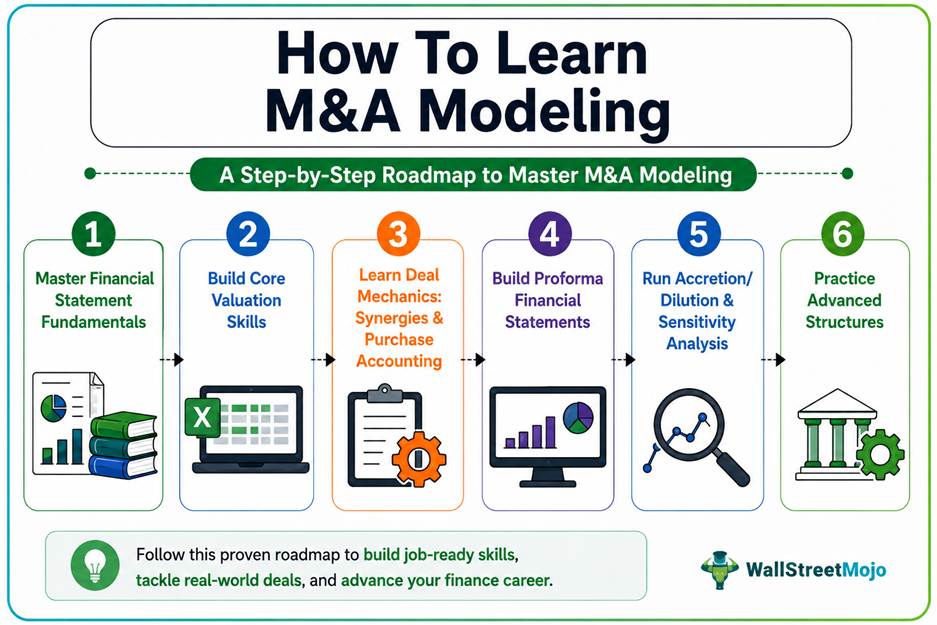
If you’re wondering how to learn M&A modeling step-by-step, start by building each skill in the correct sequence. Following this roadmap helps you develop the technical foundation required for real-world deal modeling:
Step 1: Master Financial Statement Fundamentals
Before opening a deal model, an analyst needs fluency in how the income statement, balance sheet, and cash flow statement connect. Weak statement literacy is the single biggest reason beginners stall when they try to build purchase accounting adjustments later.
Step 2: Build Core Valuation Skills
Learning to calculate enterprise value and equity value, and running a basic discounted cash flow (DCF) or comparable company analysis, gives an analyst the inputs needed to value both the acquirer and the target before a deal is even structured.
Step 3: Learn Deal Mechanics: Synergies And Purchase Accounting
This is where general financial modeling knowledge becomes M&A-specific. Analysts learn to model revenue and cost synergies, apply the purchase method of accounting, calculate goodwill, and build the deferred tax liability that purchase accounting creates.
Step 4: Build Proforma Financial Statements
The proforma balance sheet and income statement combine the acquirer and target into a single post-deal entity. This step is often the hardest for beginners because it requires linking historicals, applying every prior adjustment, and reconciling the combined entity correctly.
Step 5: Run Accretion/Dilution and Sensitivity Analysis
Once the proforma statements are built, the model needs to answer the deal’s central question: does earnings per share rise or fall after the transaction? Sensitivity analysis on EPS and debt-to-EBITDA ratios shows how the answer changes under different assumptions.
Step 6: Practice Advanced Structures
Asset purchases, tax-driven deal structures, and elections like Section 338 round out the advanced skill set that separates a generalist from an analyst who can handle complex, real-world transactions.
Skills And Tools Every M&A Analyst Must Master
Anyone looking know how to learn M&A modeling should first master specific technical skills. The table below summarizes the most important competencies and why they matter.
| Skill Area | Why It Matters | Common Tool |
| Financial statement analysis | Foundation for every model input | Excel |
| Valuation (DCF, comparables) | Sets deal pricing and negotiation range | Excel, Capital IQ |
| Purchase accounting | Determines goodwill and post-deal balance sheet | Excel |
| Synergy modeling | Quantifies deal rationale for stakeholders | Excel |
| Accretion/dilution analysis | Answers whether the deal is EPS-positive | Excel |
| Sensitivity analysis | Stress-tests assumptions for credit committees | Excel, Data Tables |
Excel remains the dominant tool for M&A modeling because deal teams need a transparent, auditable structure that investment committees and lenders can review line by line. Platforms like Capital IQ or FactSet support data gathering, but the model itself is still built and delivered in Excel on nearly every desk.
Career Paths And Salary Expectations After Learning M&A Modeling
Analysts who complete a structured M&A modeling path typically move into one of five roles: financial analyst, equity research analyst, investment banker, private equity analyst, or dedicated M&A analyst.
Compensation varies widely by firm size, experience, and geography. In the USA, on average, a mergers and acquisitions analyst earns $91,938 per year as of August 5, 2026, according to ZipRecruiter. On the other hand, in India, the typical annual salary for the same position is ₹8.6-₹11.5 lakhs for 0-5 years of experience.
Beyond dedicated M&A roles, the broader financial analyst occupation shows healthy long-term demand. The U.S. Bureau of Labor Statistics projects overall employment of financial analysts to rise by 6% from 2024 to 2034, faster than the average for every occupation, with about 29,900 openings projected each year.
Common Mistakes Beginners Make When Learning M&A Modeling
Even after learning how to learn M&A modeling, many beginners make the same avoidable mistakes. The most common ones include:
- Skipping financial statement basics: Jumping straight into a deal template without understanding how the three statements link causes errors that compound through the entire model.
- Treating synergies as a plug number: Synergies should be built bottom-up from specific cost and revenue drivers, not entered as a round percentage assumption.
- Ignoring purchase accounting mechanics: Analysts who skip goodwill and deferred tax calculations produce a proforma balance sheet that does not actually balance.
- Learning tools in isolation: Watching disconnected Excel tutorials without a case study rarely builds the judgment needed to structure a real deal recommendation.
- Underestimating sensitivity analysis: Deal committees expect a range of outcomes, not a single static answer.
Self-Study vs Structured Course: Which Path Gets You Job-Ready Faster
Understanding how to learn M&A modeling from scratch is only part of the process. Choosing the right learning approach is equally important for becoming job-ready.
For anyone wondering how to learn M&A modeling effectively, free YouTube tutorials and blog articles can explain individual concepts, but they rarely sequence financial statements, valuation, synergies, purchase accounting, and proforma modeling into one coherent case study. That sequencing is what actually builds job-ready competence, because real deals require every one of these steps to work together, not in isolation.
A structured M&A modeling course such as WallStreetMojo’s Mergers & Acquisitions Modeling Course condenses this entire roadmap into a single, end-to-end case study built around the AlphaTech and Beta Electronics transaction. Guided by Dheeraj Vaidya, CFA, FRM, a former J.P. Morgan and CLSA analyst, learners progress through each stage of the deal modeling process step by step.
The course follows the exact sequence outlined above: data gathering, synergies, purchase accounting, proforma statements, accretion/dilution, sensitivity analysis, and a final deal recommendation. Also, it comes with downloadable Excel templates and a completion certificate.
Conclusion
Knowing how to learn M&A modeling is less about memorizing formulas and more about mastering the right sequence of skills. It begins with financial statements and progresses through valuation, synergies, purchase accounting, proforma financial statements, and deal recommendations.
Beginners who want to learn M&A modeling step by step should follow that sequence rather than jumping straight into templates. This approach builds the judgment that actual deal teams rely on. For anyone ready to move from theory to a portfolio-ready model, the Mergers & Acquisitions Modeling Course by WallStreetMojo walks through the full workflow using a real case study, guided by an expert with years of industry experience.
Frequently Asked Questions
How long does it take to learn M&A modeling from scratch?
Most learners with basic Excel and accounting knowledge can build core M&A modeling competence in six to eight weeks of focused study. That said, mastering advanced structures like asset purchases and tax elections typically takes longer with continued practice on real case studies.
Do I need to know financial modeling before learning M&A modeling?
A working knowledge of financial statements and basic valuation helps significantly. That said, courses may build the foundations into the early modules. This allows complete beginners to start directly with an M&A-focused curriculum.
What is the difference between financial modeling and M&A modeling?
Financial modeling is the broader skill of forecasting a single company’s financial performance. M&A modeling applies those principles to combining two companies into a single financial model. It also incorporates purchase accounting, synergy modeling, and accretion/dilution analysis, which are not typically required in standalone financial models.
Can I learn M&A modeling without a finance degree?
Yes, a finance degree is not mandatory to learn M&A modeling, although a basic understanding of accounting and financial statements is helpful. With a structured, case-study-based course and consistent practice, learners from non-finance backgrounds can develop practical M&A modeling skills.
Which software do M&A analysts use most?
Excel remains the primary software used for building and presenting M&A models. Data platforms such as Capital IQ and FactSet are commonly used to source company financials and market information.
Is M&A modeling a good skill for private equity careers?
Yes, private equity analysts regularly evaluate acquisition targets, and the same accretion/dilution and proforma modeling skills used in investment banking directly apply to assessing buyout and add-on acquisition opportunities.