


Part of our Investment Performance Metrics guide
What Is Jensen’s Alpha?
Jensen’s alpha or Jensen’s measure refers to a measure of the excess returns earned on an investment or a portfolio compared to the gains estimated by the capital asset pricing model. It allows investors to determine whether the average return on an asset is acceptable compared to the risks.
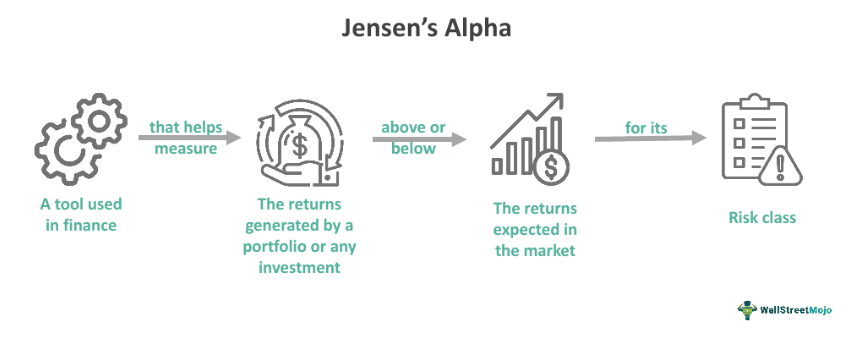
The excess returns’ value can be zero, negative, or positive; the ‘α’ symbol represents this measure. A positive Jensen’s measure indicates that the investment has exceeded performance-related expectations considering the risk level, while a negative alpha suggests underperformance. One can use this tool to assess fund managers’ skills in creating value for investors and deciding where to invest.
- Jensen’s alpha definition refers to the measure of the extra returns a portfolio generates compared to the returns projected by the CAPM.
- A key benefit of this measure is that it helps evaluate fund managers’ performance.
- The information required by one to calculate Jensen’s alpha includes market returns, risk-free rate, beta coefficient, and portfolio returns.
- A key difference between Treynor Ratio and Jensen’s alpha is that the former refers to the risk-adjusted measure of investments’ returns. On the other hand, Jensen’s measure is the excess returns earned by investments over the expected market return.
Jensen’s Alpha Explained
Jensen’s alpha definition refers to the difference between the financial gains actually earned on an investment or a portfolio and the returns that could have been generated on a benchmark portfolio associated with the exact level of market risk. This measure can help fund managers and investors determine whether an investment portfolio or a financial instrument, for example, a stock, offers superior returns owing to them taking additional risk or utilizing effective investment strategies.
Also known as Jensen’s Performance Index, it incorporates the systematic risk concept that the beta coefficient represents. Hence, it has a direct connection with CAPM or capital asset pricing model. If the price of a security is fair, it is equal to the CAPM, and the alpha is 0. That said, as noted above, the alpha will be positive and negative when the returns earned are higher or lower than the risk-adjusted returns, respectively.
Accurately analyzing an investment manager’s performance requires individuals to look at the risk associated with the portfolio besides the overall returns to find out if the financial gains compensate for the risk taken. For instance, if two mutual funds offer 10% returns. Rational investors should go for the less risky fund. One can use this tool to determine if a security or portfolio generates proper earnings considering the associated financial risk.
Formula
One can use the following formula to calculate Jensen’s alpha:
α = Rp – {Rf + β (Rm – Rf)}
Where:
- R = The returns generated by the portfolio
- Rf = The risk-free rate
- Β = The portfolio’s beta
- Rm = The expected market return
Calculation Examples
Let us look at a few Jensen’s alpha examples to understand the concept better.
Example #1
Suppose an equity mutual fund delivered a return of 18% the previous year. The expected rate of return for this particular fund is 10%. The beta versus the expected rate is 1.5, while the risk-free rate of return is 2%.
One can utilize the above formula to compute Jensen’s alpha.
- α = 18% – {2% + 1.5 x (10% – 2%)}
- or, α = 18% – 0.14
- or, α = 0.04
Considering a beta of 1.5, one can expect this fund to be riskier when compared to the index. That said, the positive alpha indicates that the fund manager earned enough to get compensated for the risk taken over the past year.
Example #2
SBI Contra Fund delivered a better performance than the other funds in its category. Moreover, it is doing well with regard to risk ratios when compared with its peers. The Jensen’s alpha ratio of this fund is 9.17, which is above the category average — 2.93. This indicates that the mutual fund has surpassed the returns expected within the market.
Advantages And Disadvantages
Let us look at the benefits and limitations of Jensen’s alpha.
Advantages
- This tool offers insight into a portfolio or investment’s performance after factoring in the associated risk level, enabling investors to compare multiple investments having different risk levels.
- As noted above, a positive Jensen’s alpha can suggest that a portfolio or financial instrument delivers above-average financial gains considering its risk level, indicating that the strategy could be more effective than the others.
- It can help one determine if a fund manager merely benefits from the overall market trends or adds any value via their investment strategies by isolating the effect of the investment decisions made by a portfolio manager from the market movements.
Disadvantages
- It can be sensitive to the changes taking place in market conditions, making it crucial for an investor to take into account how various market environments may impact the risk-adjusted performance of their portfolio.
- The calculation of Jensen’s measure involves using historical data, which may not be indicative of the investment portfolio’s future performance.
- This concept’s validity depends on the assumptions underlying the capital asset pricing model, for example, the linear relation between expected returns and risk and a risk-free rate’s existence.
Jensen’s Alpha vs Sharpe Ratio vs Treynor Ratio
The concepts of Sharpe ratio, Treynor ratio, and Jensen’s alpha can be confusing, especially for people new to finance. One must know their meaning and learn how they differ to understand how they work. In that regard, individuals must look at their distinct characteristics.
| Jensen’s Alpha | Sharpe Ratio | Treynor Ratio |
|---|---|---|
| This is the measure of the additional return generated by an investment over the market’s expected return. | The Sharpe ratio refers to the measurement of a portfolio or an investment’s risk-adjusted returns. | It is the risk-adjusted measure of an investment’s returns. |
| Jensen’s measure uses historical information. | It involves a forward-looking approach. | Treynor helps in measuring historical performance. |
| It is based on systematic risk only. | This includes both unsystematic and systematic risk. | It includes only systematic risk. |
Frequently Asked Questions (FAQs)
1. What is the difference between alpha and Jensen’s alpha?
Typically, when looking at investments or portfolios having similar beta ratios, investors or fund managers prefer the one with a higher Jensen’s measure. This is because the higher alpha implies better rewards at the same level of financial risk.
2. Is Jensen’s Alpha the same as CAPM?
No, one must remember that these two concepts are not the same. The CAPM or capital asset pricing model involves measuring the expected returns on any investment on the basis of the risk level associated with it. That said, the difference between the portfolio returns and the CAPM expected return is Jensen’s measure.
3. Who developed Jensen’s alpha?
Michael Jensen developed Jensen’s measure in 1968.
4. Is Jensen’s alpha the intercept?
It is the regression equation’s intercept within the capital asset pricing model. Moreover, in effect, it is the additional return adjusted for systematic risk.
Recommended Articles
This article has been a guide to what is Jensen’s Alpha. Here, we explain its formula, comparison with Sharpe & Treynor Ratio, examples, advantages & disadvantages. You may also find some useful articles here –